
#1 Best Crib for Short Moms (Plus a Couple More Cribs)
Finding the best crib for short moms can make everyday baby care easier, especially when you are repeatedly lifting your little one in and out of bed. Standard cribs often have high side rails that make reaching the mattress uncomfortable for shorter parents. When you are recovering from childbirth or handling a sleeping newborn, that extra reach can feel even more challenging.
Fortunately, several crib designs offer features that can help. Lower overall profiles, adjustable mattress positions, compact dimensions, and thoughtfully designed rails can make a noticeable difference without compromising your baby’s safety.
The right crib should allow you to place your baby down comfortably while providing a secure sleeping environment. It should also fit your nursery, accommodate your growing child, and meet current safety requirements.
This guide explores several crib options worth considering for shorter moms, along with the essential features to evaluate before purchasing.
Best Cribs for Short Moms
The best cribs for shorter parents balance accessibility, safety, and everyday convenience. A crib with a relatively low top rail can reduce the amount of stretching required, while adjustable mattress support allows you to use a higher mattress position during the newborn stage.
However, mattress height must be lowered as your baby becomes more mobile. A crib that feels convenient during the first few months should remain safe as your child learns to sit, pull up, and stand.
When comparing models, pay attention to the actual height of the side rails, the depth of the mattress at its lowest setting, and whether you can comfortably reach inside without standing on your toes.
Dream On Me Folding Stationary Side Crib
The Dream On Me Folding Stationary Side Crib is an option worth considering for parents who want a practical crib that can be folded away when necessary.
Its folding design makes it particularly appealing for families who need flexibility in their nursery or occasionally move the crib between rooms. Unlike traditional fixed-frame cribs, a folding model can be convenient when storage space is limited.
The stationary sides are another important consideration. Modern crib safety standards prohibit traditional drop-side designs, so parents should choose a compliant crib with secure, fixed sides.
For shorter moms, the main factor to evaluate is whether the crib’s rail height allows comfortable access. Folding functionality alone does not guarantee a lower reach, and dimensions can vary between Dream On Me models.
Features worth considering:
- Folding frame designed for convenient storage.
- Stationary sides rather than a traditional drop-side mechanism.
- Space-saving design for smaller nurseries.
- Potential suitability for occasional-use sleeping arrangements when properly assembled and approved for infant sleep.
- Practical construction for families who need a flexible setup.
Before purchasing, verify the exact model’s mattress dimensions, available mattress support positions, locking mechanism, and compliance with current CPSC crib standards.
If you plan to use the crib daily, check that the folding mechanism locks securely and that the mattress fits exactly as specified by the manufacturer.
For shorter parents, this crib may be appealing because of its flexibility, but the actual rail height should determine whether it meets your accessibility needs.
Best Convertible Cribs
Convertible cribs are popular because they can adapt as children grow. Rather than purchasing a completely new bed at every stage, parents can often convert the original crib into a toddler bed, daybed, or full-size bed, depending on the model.
For shorter moms, convertible cribs with lower profiles can be particularly useful. They may offer easier access during infancy while providing longer-term value.
However, not every convertible crib has the same height, conversion options, or mattress adjustment settings. Always check the manufacturer’s specifications before deciding.
Babyletto Hudson Crib 3-in-1 Convertible Crib
The Babyletto Hudson 3-in-1 Convertible Crib is a strong option for shorter parents who prefer a modern design with a relatively low profile.
Its rounded spindle construction gives the crib an open, airy appearance, while the streamlined frame can work well in both compact and spacious nurseries.
One of its most appealing characteristics is its low-profile design. Compared with taller traditional cribs, the Hudson may make it easier for shorter caregivers to reach the mattress without excessive bending over the rail.
The crib also features adjustable mattress support positions, allowing parents to choose an appropriate setting as their baby develops.
Key features:
- Low-profile design that can improve accessibility.
- Multiple mattress support positions.
- Converts from a crib into a toddler bed and daybed.
- Modern spindle styling.
- Compact visual appearance suitable for different nursery designs.
- Toddler bed conversion hardware included with many versions, subject to the exact package.
During the newborn stage, the highest permitted mattress position can help reduce the distance required to place your baby down. As your baby develops the ability to sit or pull up, the mattress must be lowered according to the manufacturer’s instructions.
The Hudson is especially appealing for moms who want a crib that combines attractive styling with practical access.
However, parents should still compare the published rail height with their own reach. A low-profile crib can make handling easier, but comfort depends on your height, arm length, mattress position, and nursery layout.
Delta Children Emery 4-in-1 Convertible Crib
The Delta Children Emery 4-in-1 Convertible Crib is a traditional-style option for families who want a versatile crib that can remain useful beyond infancy.
Its classic design makes it suitable for nurseries with a timeless appearance. The solid frame and convertible structure are designed to accommodate several stages of childhood.
The Emery can transition from a crib into a toddler bed, daybed, and full-size bed when used with the appropriate conversion components.
For shorter moms, the adjustable mattress support is an important feature. It allows the sleeping surface to be positioned higher when the baby is very young, reducing how far a caregiver needs to reach.
Key features:
- Four-in-one convertible design.
- Adjustable mattress support.
- Traditional styling that complements many nursery themes.
- Designed for extended use through different childhood stages.
- Compatibility with model-specific conversion accessories.
Although the Emery offers practical features, it is not necessarily as low-profile as some modern alternatives. Shorter parents should carefully examine its overall rail height before buying.
The conversion accessories may also need to be purchased separately, so it is worth checking exactly what comes in the package.
This crib may be a good choice for parents who prioritize long-term functionality and classic styling over the lowest possible side rails.
Dream On Me Violet 7-In-1 Convertible Life Style Crib
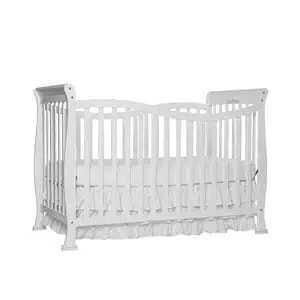
The Dream On Me Violet 7-In-1 Convertible Life Style Crib is designed for families who want a crib with several possible configurations as their child grows.
Its distinctive curved design provides a softer appearance than many rectangular, straight-edged cribs. The convertible construction is intended to offer flexibility beyond the infant stage.
Depending on the configuration and compatible accessories, the Violet can transition into toddler, daybed, and larger bed arrangements.
One feature that shorter moms may appreciate is its adjustable mattress support. The higher newborn setting can make placing a small baby into the crib more manageable.
Key features:
- Seven-in-one convertible design with multiple configurations.
- Adjustable mattress support positions.
- Curved headboard and footboard styling.
- Multiple potential sleeping arrangements as the child grows.
- Traditional wooden crib appearance.
The curved frame may appeal to parents who prefer decorative nursery furniture. However, the crib’s shape and rail height should be evaluated carefully.
For shorter caregivers, a decorative frame is not necessarily easier to reach over. The important measurement is the distance between the floor, the upper rail, and the mattress surface at each approved position.
Parents should also confirm which conversion kits are included and which must be purchased separately.
The Violet can be an attractive choice for families seeking a versatile crib, provided its dimensions allow comfortable and safe access.
Best Baby Cribs Buying Guide
Choosing a crib involves more than selecting a beautiful design or finding the lowest price. For shorter moms, the ideal crib should minimize unnecessary stretching while meeting all applicable safety standards.
A crib that is too tall may make nighttime feedings and transfers difficult. On the other hand, choosing a crib based only on its height can overlook important safety considerations.
The following features can help you identify a crib that is comfortable, functional, and appropriate for your baby’s developmental stage.
Adjustable Mattress Height
Adjustable mattress height is one of the most valuable features to look for when shopping for a crib.
Many full-size cribs offer several mattress support positions. These settings allow the sleeping surface to be raised or lowered as your baby grows.
During the newborn stage, a higher mattress position can make it easier to place your baby into the crib and lift them out. This can be particularly helpful for shorter moms who struggle to reach the bottom of a deep crib.
However, the highest position is only appropriate while your baby meets the manufacturer’s developmental requirements.
Once your baby begins sitting independently, pulling up, or reaching other specified milestones, the mattress support must be lowered promptly.
The lowest approved setting is generally used when a baby becomes more mobile and begins standing.
Never raise the mattress beyond the manufacturer’s approved positions or place objects underneath it to create additional height.
When comparing cribs, check how many mattress settings are available and whether adjusting them requires special tools.
A crib with several clearly defined settings can provide useful flexibility while helping you maintain a safe sleeping environment.
Low Profile
A low-profile crib is often one of the most practical choices for shorter parents.
The term generally refers to a crib with a relatively low overall frame or upper rail. This can make it easier to reach over the side when placing a baby down.
For a mom who is approximately five feet tall or shorter, even a small difference in rail height may affect comfort.
However, there is no single crib height that works perfectly for everyone. Your arm length, shoulder height, and the crib’s mattress depth all influence accessibility.
When shopping, consider measuring the distance from the floor to the top of the crib rail. If possible, visit a store and practice reaching into the display crib without a baby.
You should be able to reach the mattress without losing your balance, climbing onto your toes, or putting excessive pressure on your abdomen.
Avoid using stools or platforms to reach into the crib. They can create a fall hazard, particularly when you are holding a baby.
Low-profile designs should still maintain all required rail and mattress-depth safety clearances. Never modify a crib by cutting its legs, lowering its rails, or changing its frame.
Compact Size
Compact cribs can be useful for families with limited nursery space, especially when a smaller footprint allows better access around the crib.
A full-size crib typically uses a mattress measuring approximately 28 by 52 inches, while non-full-size cribs have different dimensions.
A smaller crib is not automatically lower or easier for shorter parents to use. Nevertheless, certain compact designs may offer a more convenient layout.
When evaluating compact models, consider whether there is enough room to approach the crib comfortably from the side.
Ideally, you should be able to stand close to the rail without furniture, storage baskets, or other obstacles forcing you to lean forward.
Compact cribs may also be useful in apartments, shared bedrooms, and nurseries where space is limited.
Before purchasing a mini crib or another non-full-size model, verify that it meets the applicable CPSC safety standard and uses a mattress specifically approved for that crib.
Do not substitute a full-size mattress or add padding to fill gaps.
Also remember that smaller cribs may be outgrown sooner, depending on their dimensions and the manufacturer’s limits.
For many shorter moms, a low-profile full-size crib provides a better combination of accessibility and longevity than a compact model selected solely for its smaller footprint.
Sturdy Construction
Safety and stability should always come before appearance or convenience.
A well-constructed crib should remain stable during normal use, with secure joints, properly installed hardware, and no loose or damaged components.
Current CPSC standards for full-size and non-full-size cribs address important safety issues such as structural strength, mattress support, slat spacing, and entrapment hazards.
Traditional drop-side cribs are prohibited under current U.S. safety standards and should not be used.
Before purchasing or assembling a crib, examine the following safety considerations:
- Slats should be spaced no more than 2 3/8 inches apart.
- The crib should not have broken parts, loose hardware, or missing components.
- Corner posts and decorative elements must not create clothing-entanglement hazards.
- The mattress must fit properly without dangerous gaps.
- All components should be assembled according to the manufacturer’s instructions.
- The crib must meet the applicable current safety standard.
Avoid older secondhand cribs if you cannot confirm their compliance, complete parts, and recall status.
A sturdy crib should not wobble or shift noticeably during ordinary use.
For shorter parents, stability is especially important because reaching over a crib rail can place pressure on the frame.
However, crib rails are not designed to support an adult’s full body weight. Avoid leaning heavily against them when lifting your baby.
Always follow the crib’s weight, height, and developmental limits, and transition your child to another appropriate sleep arrangement when the manufacturer specifies.
Additional Features

Beyond mattress adjustments and rail height, several additional features can improve a crib’s everyday usefulness.
Convertible functionality: A convertible crib can provide long-term value by adapting into a toddler bed or another approved configuration. Confirm that compatible conversion parts are available and follow the instructions for each stage.
Easy assembly: A crib with clear instructions and accessible hardware can simplify setup and future mattress adjustments. Never leave out screws or substitute unapproved hardware.
Safe finishes: Look for products that meet applicable limits for lead and other regulated substances. Third-party certifications may provide additional information about material emissions, but they do not replace mandatory crib safety compliance.
Smooth surfaces: Rounded edges and properly finished wooden components can help prevent scratches and reduce the likelihood of snagged clothing.
Appropriate mattress compatibility: Use a firm, flat, non-inclined mattress designed to fit the crib, covered only with a properly fitted sheet.
Simple cleaning: Smooth, wipeable surfaces can make it easier to clean up spit-up, dust, and everyday nursery messes.
Regardless of which crib you choose, follow the American Academy of Pediatrics’ safe sleep recommendations. Always place your baby on their back for every sleep, on a firm, flat surface in a safety-compliant crib.
Keep pillows, blankets, bumper pads, stuffed animals, sleep positioners, and other loose objects out of the crib. Do not use inclined sleepers or add mattress wedges.
The AAP also recommends room-sharing without bed-sharing, ideally for at least the first six months.
For shorter moms, the Babyletto Hudson 3-in-1 Convertible Crib stands out as a particularly promising option because of its low-profile design and adjustable mattress support. The Delta Children Emery and Dream On Me Violet may appeal to families who prefer more traditional styling and additional conversion possibilities, while the Dream On Me Folding Stationary Side Crib offers storage flexibility.
Ultimately, the best crib is one that you can use comfortably while maintaining a safe sleep environment throughout your baby’s development. Prioritize accessible rail height, approved mattress adjustments, sturdy construction, and verified safety compliance over decorative details alone.